
Data Engineering
Salesforce

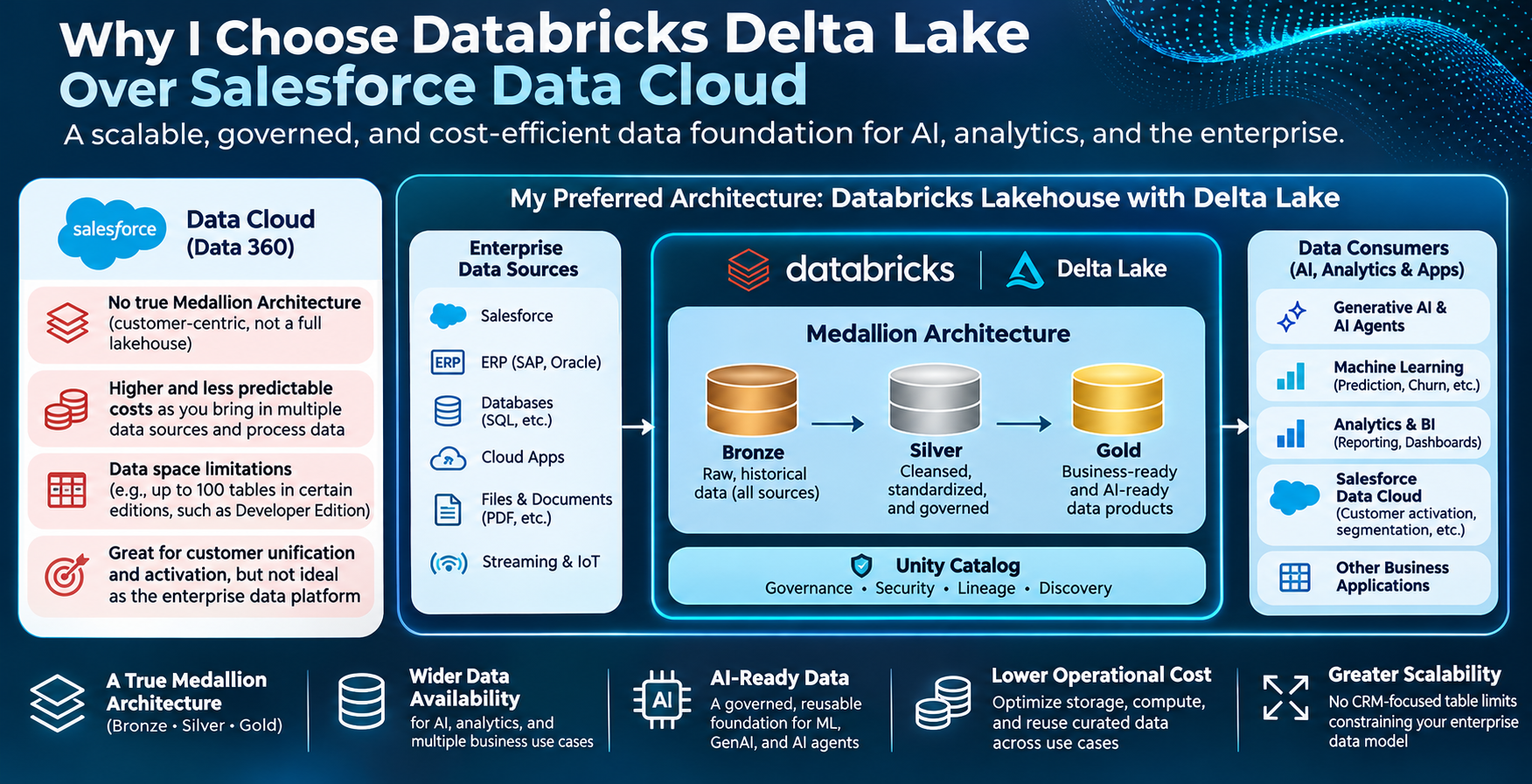
When designing an enterprise data architecture, the first question should not be which platform provides the best dashboards, customer segmentation, or AI features.
The question should be:
How do we make all enterprise data consistently available, governed, and reusable for analytics, AI, and operational applications without repeatedly moving, transforming, or paying to process the same information?
This is where I believe Databricks Delta Lake provides a stronger foundation than Salesforce Data Cloud, now branded as Data 360.
Salesforce Data Cloud is valuable for customer data unification and activating information within Salesforce. However, I would not choose it as the primary enterprise data platform when the organization needs to support multiple data sources, advanced analytics, machine learning, generative AI, and applications beyond the Salesforce ecosystem.
My preference is to establish an open, governed data foundation using Databricks and Delta Lake, then allow Salesforce and other business applications to consume the information they need.
Organizations generate valuable data across Salesforce, ERP systems, SQL databases, cloud applications, documents, event streams, and operational platforms.
AI applications need access to much more than unified customer profiles. They may need historical transactions, product information, inventory movements, service records, unstructured documents, and operational events.
Similarly, enterprise analytics requires the ability to correlate information across departments and systems.
For example, an AI solution predicting customer churn might need:
A platform that primarily organizes data for CRM activation may be useful for the final business interaction, but it should not dictate the architecture of the entire enterprise data estate.
Data should be available to AI and analytics wherever those capabilities are developed—not confined to the application that originally collected or activated it.
With Databricks, the same governed data foundation can support SQL analytics, business intelligence, predictive machine learning, AI agents, and generative AI applications.
This creates a much more reusable investment in enterprise data.
One of my strongest reasons for choosing Databricks is its natural alignment with the Medallion Architecture.
The architecture separates data into three logical layers:
Data is ingested from Salesforce, ERP systems, databases, APIs, files, and event streams while preserving its original structure and history.
This gives the organization a durable foundation for auditing, reprocessing, and introducing new analytical use cases without repeatedly extracting the same source data.
Data is validated, deduplicated, standardized, and enriched.
Customer identities can be reconciled, transactions normalized, and business relationships established.
This becomes a trusted foundation for both analytics and AI.
Curated datasets are created for specific business needs, including:
Databricks supports this architectural approach through Delta Lake, scalable processing, orchestration, and governance capabilities.
Salesforce Data Cloud provides ingestion, transformation, harmonization, and data modeling capabilities. However, its architecture is oriented toward Salesforce customer data use cases rather than providing the same general-purpose, open lakehouse foundation.
For me, the difference is important: I want the enterprise to own a reusable data architecture, rather than organize its entire data strategy around one application platform.
Traditional data platforms were often built primarily for reporting. Modern enterprise architecture must support much more.
A customer transaction dataset might be used simultaneously by a financial dashboard, a churn prediction model, an AI sales assistant, and a customer service application.
These consumers should not require separate data ingestion architectures and independently maintained copies of the same business logic.
Databricks provides a common environment for SQL, Spark-based data processing, machine learning, and AI workloads.
Delta Lake supplies reliable, versioned tables with capabilities such as ACID transactions, schema enforcement, and time travel.
Databricks adds capabilities for data discovery, governance, model development, feature engineering, and AI applications.
This is particularly important for generative AI.
An enterprise AI assistant needs accurate, current, permissioned business context. That context may come from structured tables, documents, knowledge graphs, or derived analytical datasets.
A lakehouse foundation makes it easier to establish consistent data preparation and governance before exposing information to AI applications.
Rather than building separate data pipelines for each AI initiative, organizations can reuse their existing data foundation.
The objective is not merely to connect AI to data. It is to make trusted enterprise data continuously available for AI.
Governance should not stop at the boundary of Salesforce.
An enterprise may need consistent policies for customer information, financial records, employee data, and sensitive operational information across many consuming applications.
Databricks Unity Catalog provides centralized capabilities for access control, data discovery, lineage, and governance across supported data and AI assets.
This allows organizations to establish a common governance approach for analytics and AI workloads.
For example, sensitive customer fields may need to be masked for analysts while remaining available to approved operational processes. AI applications may require additional controls to prevent unauthorized access to information.
The advantage is that governance can be designed around enterprise data domains and consumption requirements rather than a single CRM use case.
Salesforce Data Cloud also has governance and access-control capabilities, and these remain important when data is activated inside Salesforce.
My architectural preference is to establish governance at the shared enterprise data foundation and then apply appropriate additional controls in downstream applications.
Cost is another major consideration.
When integrating multiple enterprise systems, the total cost is not simply the initial cost of bringing information into a platform.
It includes ingestion where applicable, transformation, harmonization, querying, identity resolution, segmentation, activation, and ongoing processing.
Salesforce Data 360 pricing has evolved, including free batch ingestion and zero-copy integrations in supported scenarios. Therefore, it would be inaccurate to suggest that every external data ingestion automatically consumes credits.
Nevertheless, credit-based consumption can make forecasting more complicated when many workloads continuously process and activate data.
As the number of sources, refresh frequencies, users, and downstream workloads increases, organizations need to understand the cumulative cost of those activities.
Databricks is not free, and its compute, storage, networking, and managed-service usage must also be controlled.
However, a lakehouse architecture gives organizations more direct opportunities to optimize workloads through storage separation, incremental processing, workload scheduling, compute sizing, and reuse of curated datasets.
Instead of processing the same business information independently for different applications, the organization can prepare it once and make it available to multiple consumers.
That is where I see the potential for meaningful operational savings.
The cost advantage comes from architectural reuse and workload optimization—not from assuming that one platform has no consumption charges.
Salesforce Data Cloud has platform limits and edition-specific entitlements that must be considered during solution design.
For example, Salesforce Developer Edition documentation identifies a 100 Data Lake Object limit at the organization level. That should not be confused with a universal 100-table limit for every production data space. Other editions have different published limits.
The larger architectural concern is not a single numerical limit.
It is whether an enterprise wants its central data architecture constrained by the object model, licensing, and platform-specific boundaries of a CRM-oriented data product.
As data domains expand across finance, supply chain, manufacturing, healthcare, and AI applications, the enterprise needs an architecture that can evolve without requiring every new workload to fit the same application-specific model.
Delta Lake offers an open table format and a broader ecosystem for managing large-scale structured and semi-structured data.
That flexibility becomes increasingly valuable as enterprise data grows.
I am not suggesting that Salesforce Data Cloud should be eliminated.
It is well suited to scenarios such as customer identity unification, segmentation, Salesforce personalization, and activating customer information within Salesforce workflows and Agentforce.
The architectural distinction is where each platform belongs.
I would use Databricks as the primary enterprise data foundation and Salesforce Data Cloud as a specialized consumer and activation platform when the business case justifies it.
Enterprise Sources → Databricks Lakehouse → Governed Data Products → AI, Analytics, and Business Applications
Architectural layerPreferred approachData ingestionDatabricks pipelines and appropriate integration servicesRaw data storageDelta Lake BronzeData quality and standardizationDelta Lake SilverBusiness-ready datasetsDelta Lake GoldEnterprise governanceUnity CatalogBusiness intelligenceDatabricks SQL, Power BI, Tableau, or other BI toolsMachine learning and AIDatabricks ML and AI capabilities, plus external AI services as neededCRM data activationSalesforce Data Cloud where appropriateSalesforce AI workflowsAgentforce consuming relevant governed business context
Where supported and practical, zero-copy and federation approaches can further reduce unnecessary duplication between platforms.
This architecture preserves the value of Salesforce while avoiding unnecessary dependence on it as the enterprise's central data repository.
Enterprise AI initiatives frequently struggle not because the models are inadequate, but because the underlying data is fragmented, inconsistent, inaccessible, or poorly governed.
Organizations may invest in AI agents and advanced analytics only to discover that every new use case requires another integration project.
A well-designed lakehouse changes that pattern.
Data ingestion, quality, standardization, historical preservation, governance, and reusable business definitions become shared enterprise capabilities.
When a new AI application is introduced, much of the data preparation work has already been completed.
This can reduce time to market, improve consistency, and limit duplicated engineering effort.
It also provides architectural freedom. Organizations can introduce new models, analytical engines, and applications without redesigning their entire data foundation.
That flexibility is especially important in an AI landscape where technologies and business requirements continue to evolve.
My decision to choose Databricks Delta Lake over Salesforce Data Cloud as the primary enterprise data platform comes down to three priorities:
Data availability: Enterprise data should be reusable across AI, analytics, and operational applications.
Architectural flexibility: A governed Medallion Architecture provides a clear, scalable foundation independent of any single business application.
Operational efficiency: Shared pipelines, reusable datasets, and optimized processing can reduce duplication and improve long-term cost control.
Salesforce Data Cloud remains valuable for Salesforce-specific customer data activation. But that does not automatically make it the best place to build the entire enterprise data architecture.
I would rather build a trusted, open, AI-ready enterprise data foundation with Databricks and Delta Lake—and let Salesforce, analytics platforms, and AI applications consume that data as needed.
The future of enterprise AI is not about moving all your data into one application. It is about making governed, reliable data available to every application and AI capability that needs it.
Have a question or just want to say hello? Here's how you get started.


