
AI

Why This Migration Breaks Down—and How Escape-Force Helps You Get It Right
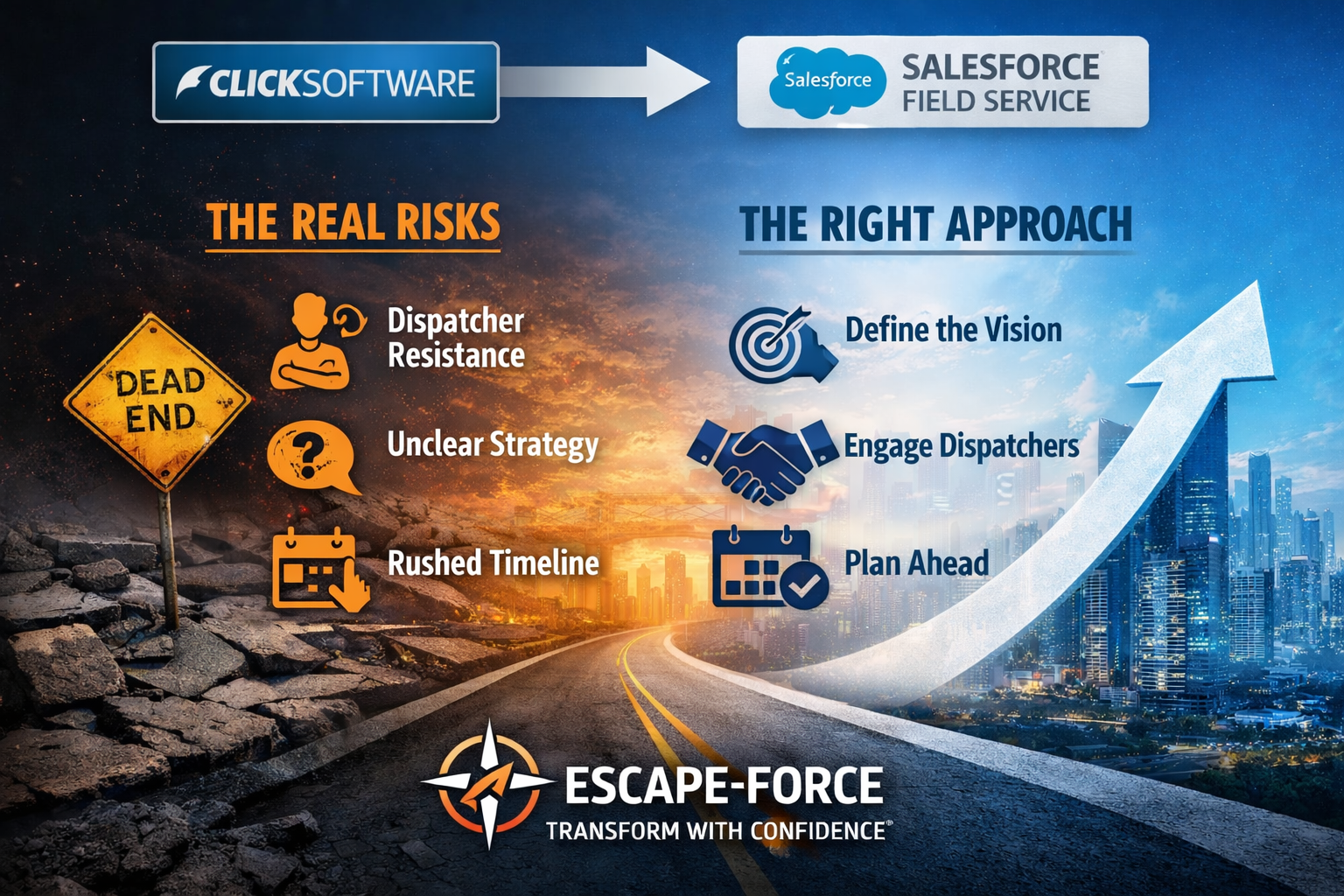
For years, ClickSoftware has quietly powered some of the most complex field service operations in the world. Dispatchers trusted it. Technicians relied on it. And leadership rarely questioned it—because it worked.
Now, with ClickSoftware reaching end-of-life, organizations are being forced to migrate—most often to Salesforce Field Service.
On the surface, this looks like a natural evolution. Same ecosystem. Modern platform. Clear future roadmap.
In practice, this migration is far more complex than most organizations expect—and not for the reasons they assume.
At Escape-Force, we see the same pattern repeatedly:
the technology works, the project plan looks solid, and yet the business struggles post go-live.
Here’s why.
The biggest risk isn’t technology—it’s behavior
Most migration programs start with a technical mindset:
- Feature comparison
- Integration mapping
- Data migration
- Cutover planning
Those are necessary—but they are not the hard part.
The hardest part is unpacking how Click is actually used today.
In mature Click environments:
- Scheduling logic has evolved over years
- Critical decisions live in dispatcher habits, not configuration
- Manual overrides compensate for undocumented rules
- “It works” is accepted without full understanding of why
When teams attempt to recreate this behavior blindly in Salesforce Field Service, they hit friction fast.
Salesforce is built to reward explicit rules, automation, and governance.
Click thrived on implicit knowledge and dispatcher intuition.
That mismatch—not missing features—is where migrations fail.
The fork in the road most organizations underestimate
Every Click migration eventually reaches a decision point, whether explicitly or not:
Do we replicate the past—or redesign for the future?
Some organizations aim for a tactical migration:
- Minimal process change
- Familiar dispatcher workflows
- Fast delivery
Others pursue a transformative migration:
- Improved scheduling logic
- More automation
- Better scalability and insight
The danger is not choosing one over the other.
The danger is starting tactically and drifting into transformation halfway through, without resetting scope, timeline, or expectations.
That’s when projects stall, costs rise, and trust erodes.
At Escape-Force, we help clients make this decision early—and commit to it deliberately.
Dispatchers are the hidden power center
One truth we see across industries:
If dispatchers don’t trust the new system, the migration has already failed.
Dispatchers are not casual users. They are:
- Operational experts
- Decision makers
- Guardians of service performance
When a new system feels less predictable or less controllable:
- Optimizers get overridden
- Manual scheduling returns
- Automation value disappears
This is why Escape-Force treats dispatchers as co-designers, not just end users.
Their knowledge must be extracted, documented, and intentionally translated—not ignored or overridden.
Time pressure turns good decisions into bad ones
Many organizations delay migration until end-of-life feels “close enough.”
At that point:
- Tactical shortcuts become mandatory
- Testing windows shrink
- Redesign becomes impossible
- Optimization is postponed indefinitely
The result?
A system that technically replaces Click—but never truly improves the operation.
Escape-Force consistently advises clients to finish early enough to stabilize and optimize, not just go live.
Data migration: knowing what to leave behind
Another quiet challenge is historical data.
Click environments often contain:
- Years of scheduling artifacts
- Legacy objects with unclear value
- Data optimized for a different architecture
Trying to migrate everything “just in case” increases:
- Complexity
- Performance risk
- User confusion
Modern field service platforms perform best with clean operational data, supported by archived history where needed.
This is a business decision, not a technical one—and it requires executive clarity.
How Escape-Force approaches Click migrations differently
Escape-Force was founded on a simple principle:
independent, vendor-agnostic second opinion before irreversible decisions are made.
In Click migrations, that means we focus on:
- Behavior before technology
We decompose how scheduling, dispatch, and overrides actually work today. - Explicit design decisions
What becomes a rule?
What becomes automation?
What becomes an exception—or disappears entirely? - Dispatcher trust as a success metric
Adoption is not assumed. It is designed. - Clarity over comfort
We help leaders choose tactical or transformative paths intentionally—not accidentally. - Future-proofing, not feature chasing
The goal is not to rebuild Click.
The goal is to build a service operation that scales.
Final thought
This migration is not about replacing a scheduler.
It is about deciding how your field service organization should operate in a modern, AI-driven enterprise.
Organizations that treat this as a checkbox exercise will survive end-of-life.
Organizations that treat it as an opportunity for clarity and redesign will outperform their peers.
That’s where Escape-Force comes in.

%20(1).png)
Let’s Talk
Have a question or just want to say hello? Here's how you get started.


Hours of Operation
Mon - Fri
9 AM - 5 PM CST
Saturday
Closed
Sunday
Closed
Location
Dallas, TX 75201
Phone
Drop us a message via our contact form first—kind of like a secret handshake. Then, we’ll reveal the sacred company phone number (to keep the spam bots at bay)!
Thank you! Your submission has been received!
Oops! Something went wrong while submitting the form.


